The word “Rann” means “desert” and as the name suggests, “Rann Of Kutch”, located in Kutch district of Gujarat is an extension of the Thar Desert, but the difference rests in the fact that it is primarily a “salt desert”.
The Rann of Kutch, in India is broadly divided into two parts – the Great Rann & the Little Rann of Kutch. Situated at the very edge of Indo-Pak border, the distinctive landscape of the Great Rann offers a wondrous trip for tourists & travelers alike.
The vast expanse of white has loads to offer.
Hold on! The relief features characterizing the Great Rann are splendid since it is an amalgamation of boundless salt stretches, expansive arid desert plains, beautiful hills overlooking the Arabian Sea and islands surrounded by the huge Kutch Lake.
An ideal trip to the Great Rann of Kutch shall necessarily cover- stays at Bhuj & Dhordo along-with a visit to the adjacent Salt Desert that hosts the Rann Utsav; a visit to Kalo Dungar hill which is the highest point of Kutch; & most importantly a drive or ride through the “Road To Heaven” cutting across the vast Kutch Lake – to time travel back to the ancient Harappan city of Dholavira located at the island of Khadirbet.
Winter (November – February) is the best season to explore the Rann.
Here’s a your ultimate travel blueprint for a trip to the Great Rann of Kutch–
Bhuj
This city serves as the headquarters to the largest district in India i.e. Kutch. A day or at the most two in Bhuj is sufficient to explore this old town rich in heritage and tradition.
The Smritivan Earthquake Memorial & Museum is a must visit site in Bhuj. This large museum offers lots to explore and to learn about. Smritivan was raised in memory of the victims of the devastating earthquake which had struck the city in 2001. The museum offers “Seven” galleries to be explored which provides a detailed walk-through the creation of Earth, evolution of landforms, life, human beings, cultures, and through ancient civilizations mostly dwelling on the Indus Valley civilization. The museum also deliberates on modern history and developments in science & technology. Just adjacent to Smritivan is the Bhujia fort situated atop the Bhujiyo Dungar or hill. Experiencing sunset atop this hill is a beautiful experience as well.
Tourists interested in history, particularly the colonial past of this country may visit the Prag & Aina Mahals. Do visit the Kutch museum if you are interested in the tradition, heritage, and local tribal lifestyle & cultures of Kutch district in India and also of the Sindh province of Pakistan. Temple-goers and students of architecture must necessarily visit the Shri Swaminarayan temple in Bhuj.
An evening stroll around the beautiful Harmirsar Lake and a bit of shopping at the local market places should be an apt way to conclude your trip to Bhuj.
Then arrives the day next and one is ready to venture into the phantasmagorical landscape of the Great Rann of Kutch.
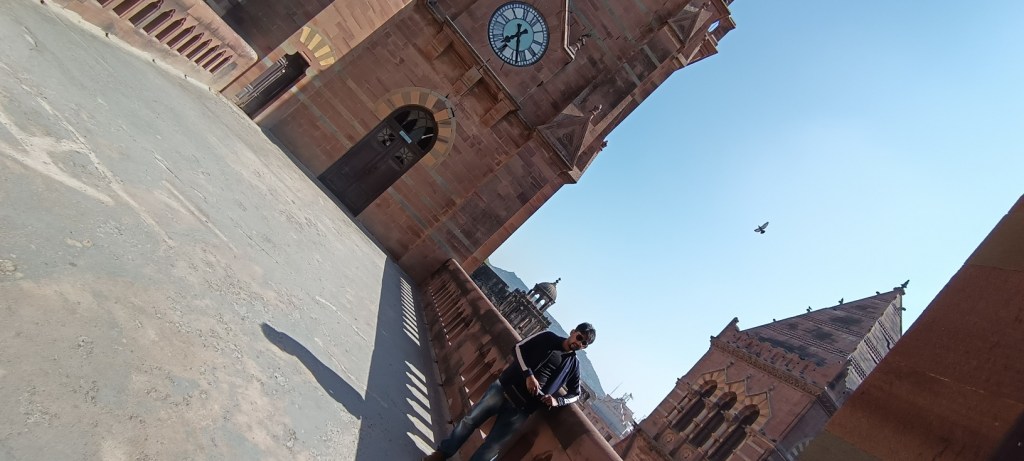
Prag Mahal, Bhuj
The Rann Utsav site & the gateway to the Safed Rann (the salt flats), Dhordo
The village of Dhordo is quite well-known thanks to the world famous Rann Utsav. This hinterland owing to its proximity to the Indo-Pak border necessitates tourists to obtain permits from the authorities for visiting this place. Permits can be obtained both online and offline.
The village of Dhordo is located at a distance of about 86 kilometres from the city of Bhuj. Enthusiasts may also hire 2-wheelers or cars from Bhuj itself and self-ride or drive to the Rann.
The landscape starts to change and bares forth the arid desert as soon as the traveler leaves the town of Bhuj and approaches the countryside. Trees get out-numbered by short shrubs and bushes, and the yellowish soil sometimes seems red, sometimes pinkish as well as blackish. At multiple places the earth also gives way to whitish swampy patches which indicates high salinity.
Suddenly in the middle of nowhere, there appears a board at the side of the tarmac, a careful glance nudges one to stop and realize that he or she is standing exactly at “twenty-three & a half degrees north of the equator”i.e. at the Tropic of Cancer.
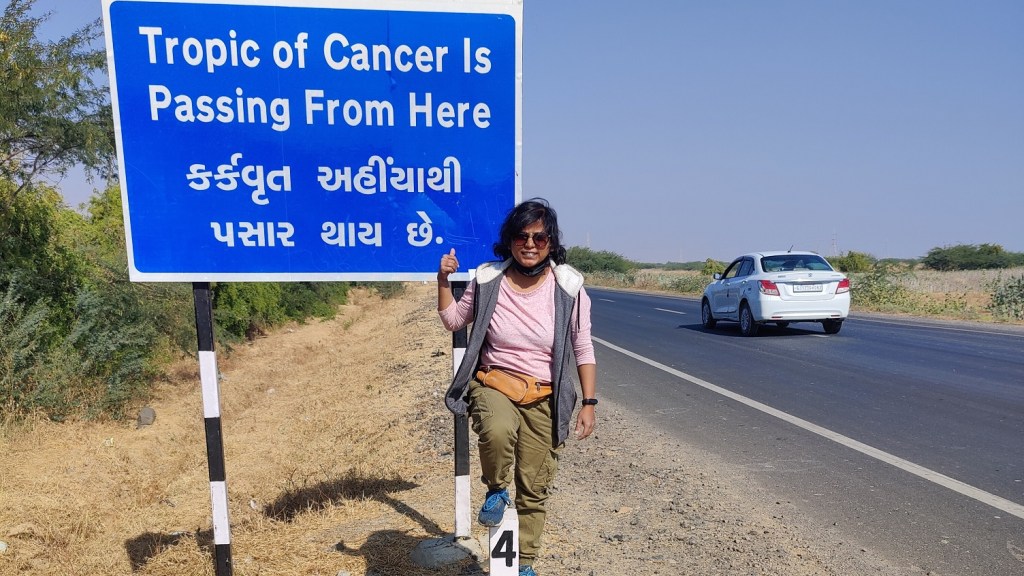
A few kilometres away, one comes across the Bhirandiara check-post. Obtain the permits to visit the White Rann at Dhordo incase you haven’t been able to gather it yet. Take a small break and enjoy the locally made hot “mawa” from the small shops located near the check post. For the uninitiated, “Mawa” is a Kachhi sweet-dish a variant of the more popular “milk-cake”.
The road which divulges leftwards from the Bhirandiara check-post leads to Dhordo. Dhordo is located at about 30 kilometres from the Bhirandiara check post. On your way to Dhordo, you will get to see “Bhungas” – round shaped mud huts with thatched roofs. These traditional mud-houses are fairly earthquake resistant and help in keeping the interiors cool during the ruthless summer months while providing warmth during the winters. One also passes by several nomadic bands walking past along with their herds of cattle, mainly sheep & camels.
Dhordo offers lots of stay options; and depending on preference and budget one may choose a resort or a camp-site. Nearby villages offer several homestay options as well. Staying at a Bhunga or a tent in a hotel or a campsite near the check-post, serving as the gateway to the expansive salt marsh is bound to be a great experience.
The focal attraction of the Rann Utsav is the unending stretch of white desert. Experiencing the setting Sun and the rising moon at dusk is an indescribable affair. The sight is absolutely mesmerizing. Walking on the dried up ocean bed covered fully with layers of hardened salt flats compels one to ponder over the beauty of existence.
The horizon remains unfathomable since it’s white all around. The best time to visit the White desert is during the full moon phase since it is during this phase that the desert reveals its full glory.
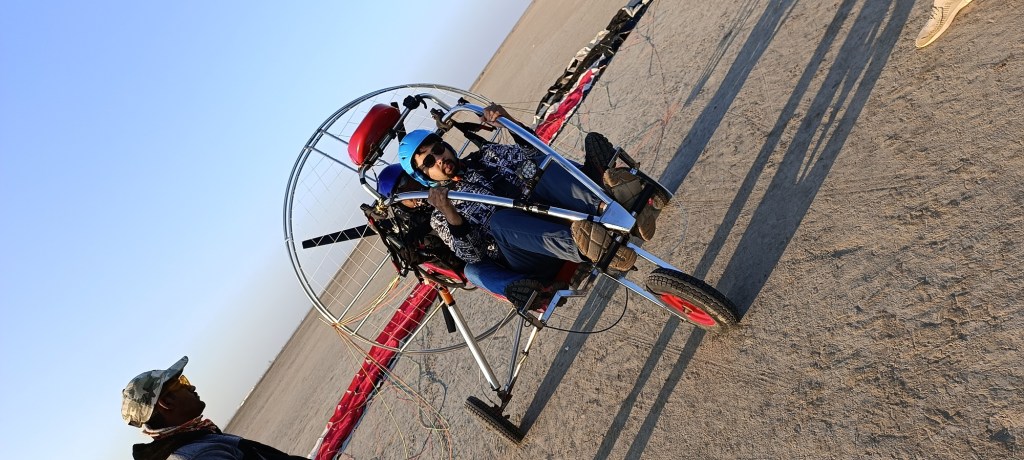
Tourists can indulge in various adventure sports activities like Paramotoring, Hot-air ballooning, ATV rides etc. One may also enjoy a camel safari. The view of the white expanse, camouflaged horizon along with the view of the setting sun and rising moon at dusk or the rising sun and setting moon at dawn is a sight to behold.
In the evening, the mela ground in Dhordo is a nice place to hang out, taste authentic Gujarati cuisines, and splurge on traditional Gujarati dress and local handicrafts. You may also indulge in the folk performances at your respective resorts & camp sites.
Hold on! The night is not yet over. It’s full moon and you must venture into the White desert at the midnight hour to soak in the burning white of the moon-blanched land and most importantly to promise to come back the next dawn to hail the rising Sun.
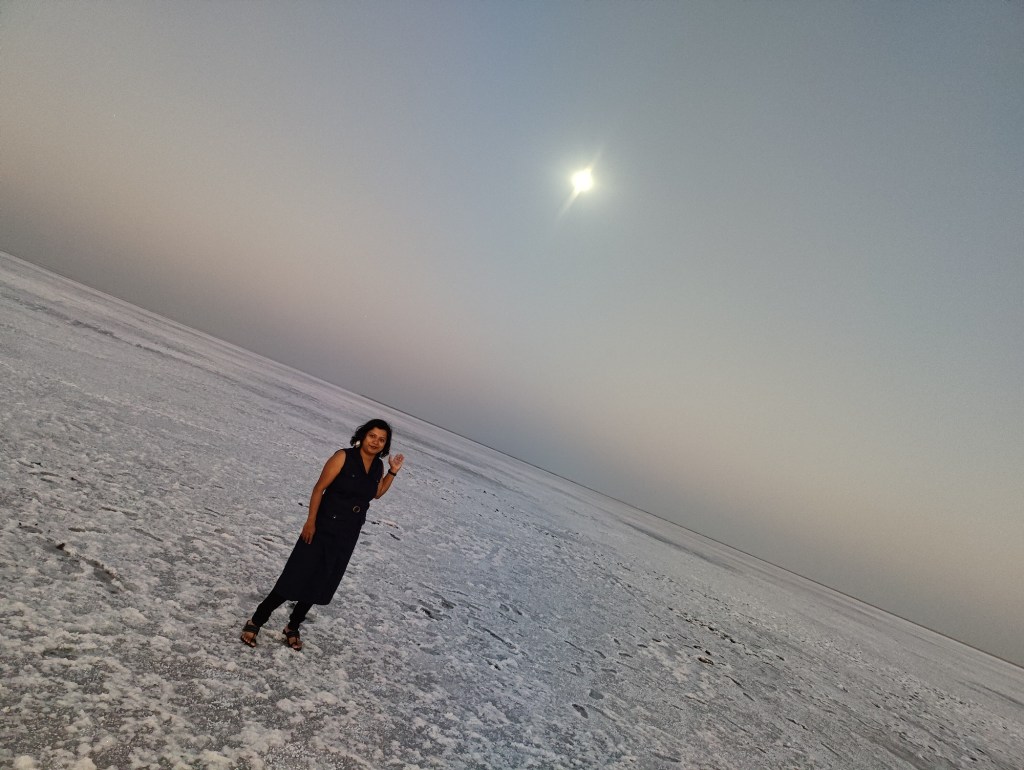
at Dusk
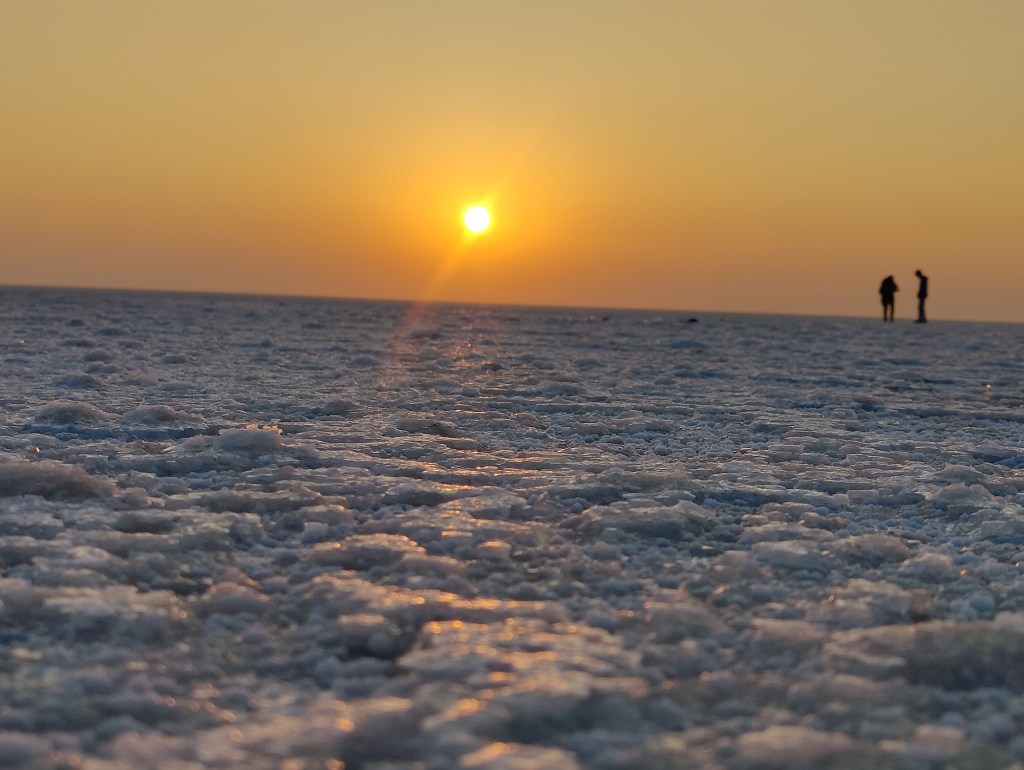
at dawn
Magnetic hill & Kalo or Kala Dungar
The next day tourists can enjoy a day trip to a nearby place called Kalo Dungar (black hill) and some other sites as well if time permits. The word “Dungar” means a hill or a hillock. Kala Dungar is the highest point in Kutch.
The place is located at a distance of about 40 – 45 kilometres from “Dhordo” and may take an hour or at max two to reach. Best way to reach Kalo Dungar from Dhordo is by traveling through the Gujarat state highway which connects Khavda with Dhordo. Though it is currently a single lane highway through which salt ferrying trucks navigate day in and day out, but the beauty of this highway lies in the fact that it runs through a beautiful sand desert. You may also find one or two small sarobar in between, frequented by migratory birds, mainly “flamingos”.
The final stretch to Kalo Dungar passes through a magnetic hill, which is a unique experience in its own way. Do stop for some time at this place to get a first hand experience of anti-gravity pull.
On reaching Kalo Dungar pay a visit to Dattatreya Mandir if you wish and then walk or take a camel ride till the top of the hill. It’s better to take the hike and on your way listen to Gujarati or Sindhi folk music sung by local fakirs.
The hilltop offers a majestic view of the Great Rann of Kutch, the Arabian Sea & its long distinct coastline marked by both sand and salt flats, and the adjoining hills.
Kalo Dungar is situated at a distance of about 52 kilometres from Indo-Pak border and one can spot through binoculars the strategically important India Bridge, India’s last village & border outposts, and the Indo-Pak border.
Tourists may also visit India Bridge, however a visit to this place solely depends on permission from the paramilitary or defense personnel present at the check-post.
Road To Heaven & Dholavira
Dholavira is the fifth largest Indus valley Civilization site. This ancient city is located in the island of Khadirbet in Rann of Kutch and is surrounded by the Kutch Lake.
The best way to reach Dholavira from Dhordo or Dhordo is via the scenic Road to Heaven i.e via the Aadhav – Dholavira road after crossing Bhirandiara or Khavda. If you are traveling from Dhordo then you may skip Bhirandiara and directly reach Khavda through the state highway.
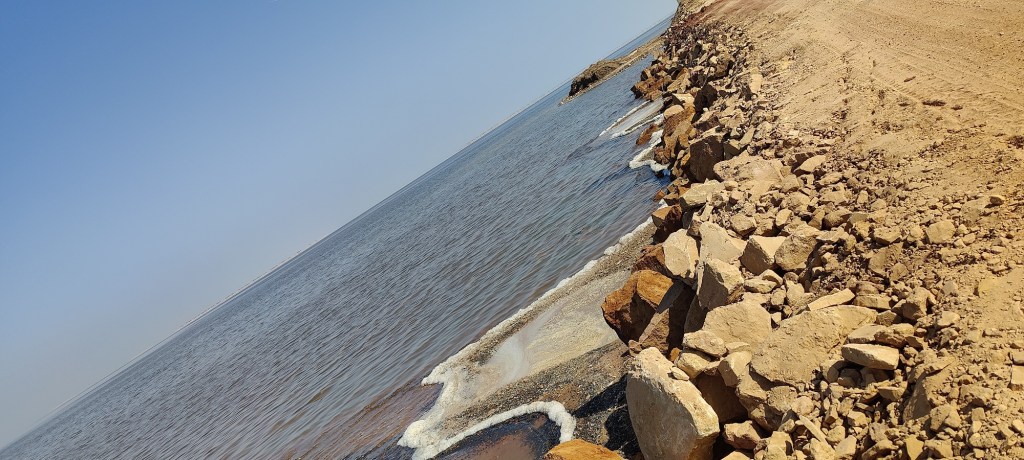
Road to Heaven is a 30 kilometres long stretch which cuts across the Kutch lake and connects the mainland with the island of Khadirbet famous for the UNESCO World Heritage site i.e. Dholavira. As the name suggests, the ride through this heavenly road is truly enchanting and hypnotic.
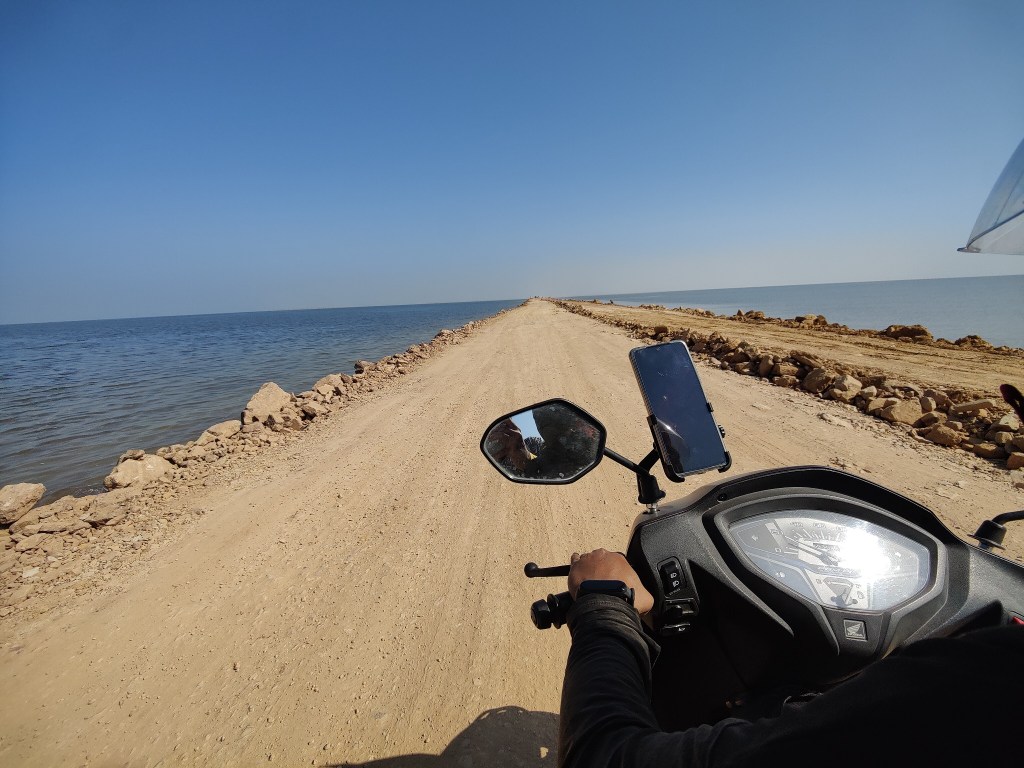
The traveler gets captivated by the view of the vast lake on both sides of the road and gets enthralled by its nothingness. The journey seems unending and the view awe-inspiring. Here one gets to see lots and lots of flamingos and it is due to their reflection on water, topped with the presence of salt that at places the crystal blue lake turns pink.
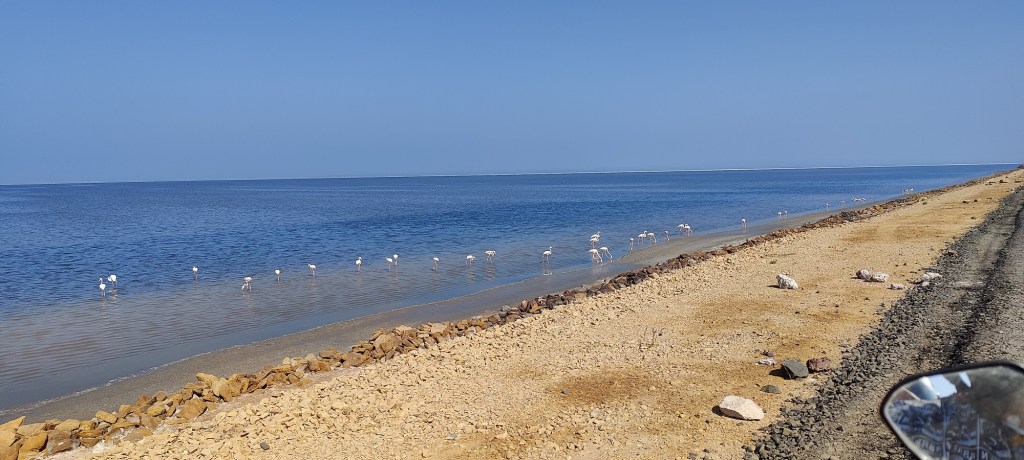
flamingos wading the shallow waters of the Kutch Lake
After a certain point, the lake water gives way to dried up salt bed and the entire landmass turns absolute white. It is noteworthy that this part of the salt desert is a million times better than Dhordo and is still majorly untouched or unexplored.
Caution! The road is at present under construction and remains mostly deserted. The stretch is also devoid of any shop or fuel station or houses hence careful and safe driving or riding is required. Most importantly night travel through this route must be avoided.
Dholavira has ample stay options and a two night’s stay at this remote island is enough to unwind, learn and reconnect with our origin and evolution.
Places to be explored in Khadirbet Island –
Kotada Timba i.e. the ancient metropolis of Dholavira
This heritage site is an archaeological marvel which lays bare the engineering genius of the Indus Valley people. The town planning, and most imperatively the water conservation techniques, reservoirs & drainage system that the kingdom of Dholavira showcases makes one wonder and ponder on the greatness of humankind. One gets to learn about two prominent rivers Manhar & Mansar and how the water from these streams were utilized for general usage. The ruins uphold a very organized societal & administrative structure.
It is better to take a guide to better explore this place.
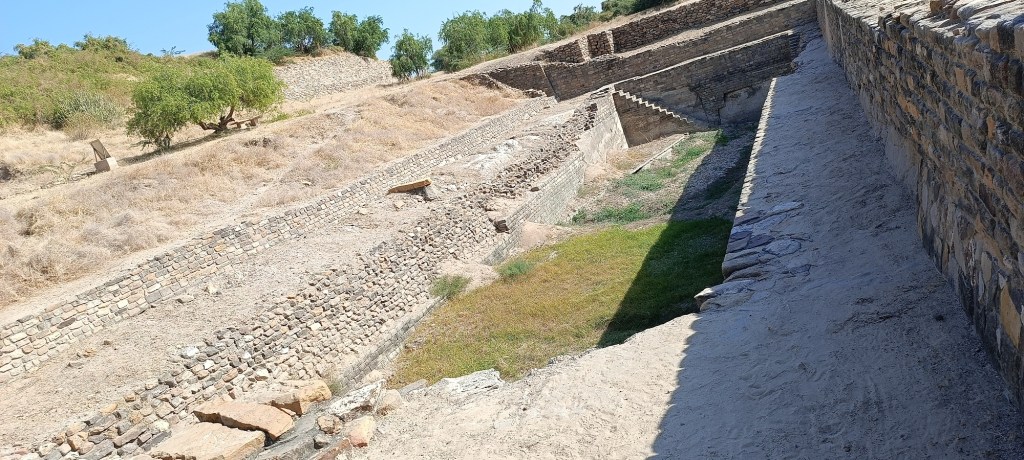
Archeological site at Dholavira
Wood Fossil Park
At a distance of about five kilometres from the Harappan site, lies a wood fossil park where one can get amazed at the site of Jurassic or pre-historic era fossils as old as 160 million years.
The view of the Kutch lake, coast line and the distant Bhanjano hills is just inexplicable.
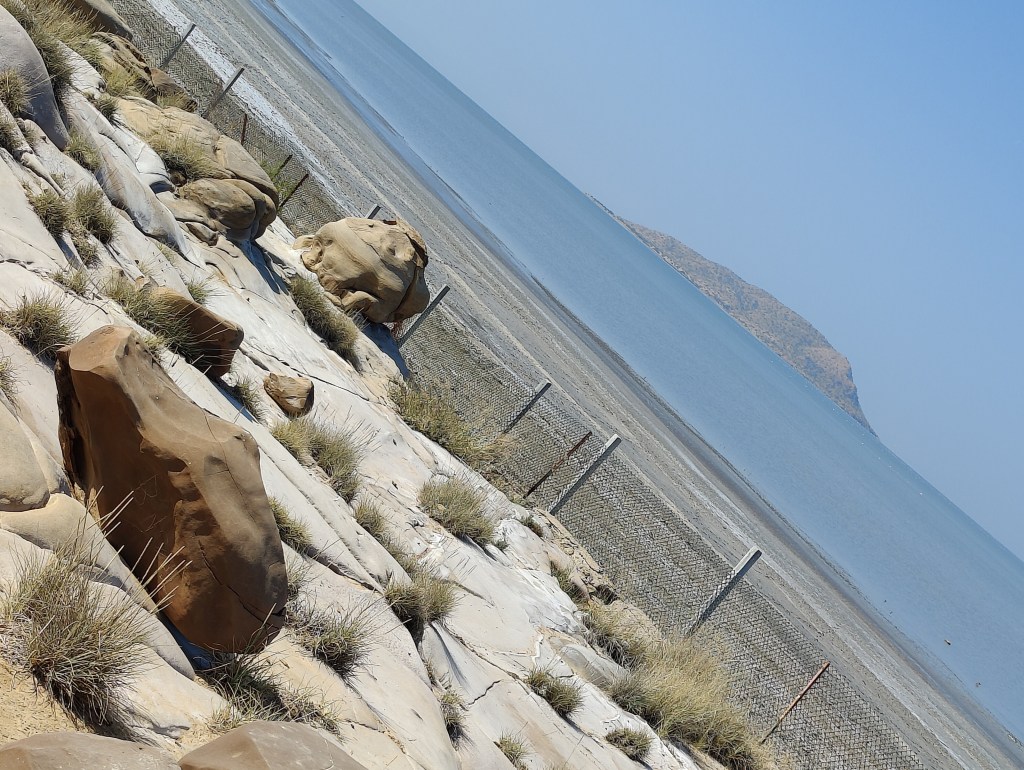
at Wood Fossil Park. The distant tilla visible is the beautiful Bhanjano Hill
Near to the fossil site lies a sunset view point and a small mandir maintained by the paramilitary forces.
Chipper Point
This point is located atop a hill and is actually a jutting or protruding rock which imparts a dangerous beauty to its admirers. It is advisable not to step into or tread to the edge of this rock. This point or rather the entire edge of this hill feels as if it has all of a sudden broken down and opened up to a dried up sea with a long distinct shoreline and unending salt flats. The view from Chipper Point seems incredible at dusk.
Stay Options at Dholavira or Khadirbet Island
The island of Khadirbet more popularly known as Dholavira has ample stay options.
If you are entering this island through the Road To Heaven and want to visit the Harappan Metropolis and Fossil park at first then book your stay near to it. Rann Resort Dholavira just at the terminal point of Road to Heaven is a great property and has a wonderful access to the beach i.e. the beautiful White Rann which in turn gives way to the Kutch lake. However, the property is not that budget friendly especially if you are visiting this place during the full moon phase.
More economical options can be explored near to the other side of the Khadirbet Island which falls near to Chipper Point. The villages of Ratanpar, Amarapar & Ganeshpar in the island offers good stay options in the form of resorts, hotels and homestays. Khadir Homestay Resort is a good option to stay as well. The property gets a thumbs up due to the homely vibe that it lends to its boarders.
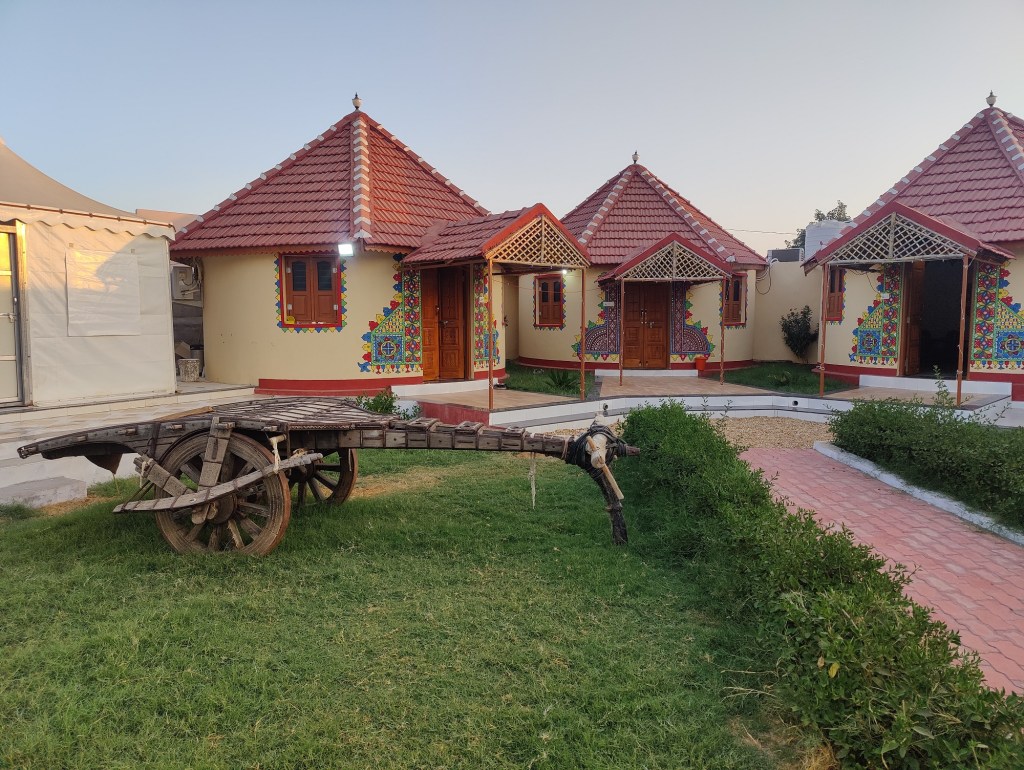
our stay at Khadirbet Island
Safari to the salt Desert during the mid-night hour
If you are at Dholavira, this is a must. Since this part of the salt desert is a lot better and harder, go for an expedition during the night into the Rann and get moon bleached incase it’s a full moon night or else spend your time star-gazing on a no moon or dark moon night.
Return
If you have already trudged the “Road to Heaven” while entering Dholavira, then for traveling back to Bhuj, you may take the Khadir Bet Road and then after reaching mainland take the Rapar – Bhachau highway which connects the other end of the Khadirbet Island with the major cities.
The ride through the Khadir Bet road also offers unhindered views of the White Rann. The road also runs across the dried up Kutch lake for a distance of about 8 kilometers presenting a perfect way to bid adieu to the Great Rann of Kutch.
The opportunity to travel backwards right from the Indus Valley civilization era till the pre-historic period and then to return back to present day makes the trip to Dholavira unprecedented.
The unparalleled relief features of the Great Rann inclusive of – vast expanse of salts, arid grounds, and rugged hillocks overlooking the Arabian Sea and its encroaching waters leading to the formation of the Kutch Lake truly justifies the tagline “Kutch Nahi Dekha Toh Kuch Nahi Dekha”.

 Untrodden Boulevards